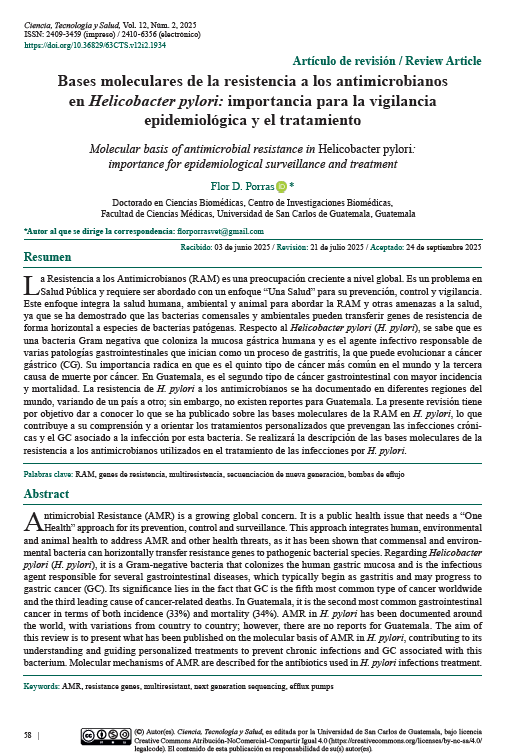
Molecular basis of antimicrobial resistance in Helicobacter pylori: importance for epidemiological surveillance and treatment
DOI:
https://doi.org/10.36829/63CTS.v12i2.1934Keywords:
AMR, resistance genes, multiresistant, next generation sequencing, efflux pumpsAbstract
Antimicrobial Resistance (AMR) is a growing global concern. It is a public health issue that needs a “One Health” approach for its prevention, control and surveillance. This approach integrates human, environmental and animal health to address AMR and other health threats, as it has been shown that commensal and environmental bacteria can horizontally transfer resistance genes to pathogenic bacterial species. Regarding Helicobacter pylori, it is a Gram-negative bacteria that colonizes the human gastric mucosa and is the infectious agent responsible for several gastrointestinal diseases, which typically begin as gastritis and may progress to gastric cancer (GC). Its significance lies in the fact that GC is the fifth most common type of cancer worldwide and the third leading cause of cancer-related deaths. In Guatemala, it is the second most common gastrointestinal cancer in terms of both incidence (33%) and mortality (34%). AMR in H. pylori has been documented around the world, with variations from country to country; however, there are no reports for Guatemala. The aim of this review is to present what has been published on the molecular basis of AMR in H. pylori, contributing to its understanding and guiding personalized treatments to prevent chronic infections and GC associated with this bacterium. Molecular mechanisms of AMR are described for the antibiotics used in H. pylori infections treatment.
Downloads
References
Alfaray, R., Saruuljavkhlan, B., Fauzia, K., Torres, R., Thorell, K., Dewi, S., Kryukov, K., Matsumoto, T., Akada, J., Vilaichone, R., Miftahussurur, M. & Yamaoka, Y. (2023). Global antimicrobial resistance gene study of Helicobacter pylori: Comparison of detection tools, ARG and efflux pump gene analysis, worldwide epidemiological distribution, and information related to the antimicrobial-resistant phenotype. Antibiotics,12, 1118.. https://doi.org/10.3390/antibiotics12071118
Ansari, S., & Yamaoka, Y. (2022). Helicobacter pylori infection, its laboratory diagnosis an antimicrobial resistance: a perspective of clinical relevance. Clinical Microbiology Reviews, 35(3), Artículo e00258-21. https://doi.org/10.1128/cmr.00258-21
Argueta, E. A., Ho, J. J. C., Elfanagely, Y., D’Agata, E., & Moss, S. F. (2022). Clinical Implication of Drug Resistance for H. pylori Management. Antibiotics, 11(12), Artículo 1684. https://doi.org/10.3390/antibiotics11121684
Blair, J. M. A., Webber, M. A., Baylay, A. J., Ogbolu, D. A., & Piddock, L. J. V. (2015). Molecular mechanisms of antibiotic resistance. Nature Review of Microbiology, 13, 42-51. https://doi.org/10.1038/nrmicro3380
Contreras, M., Mujica, H. & García-Amado, M. A. (2024). Molecular tools of antibiotic resistance for Helicobacter pylori: An overview in Latin America. Frontiers in Gastroenterology, 3, Artículo 1410816. https://doi.org/10.3389/fgstr.2024.1410816Diallo, O. O., Baron, S. A., Abat, C., Colson, P., Chaudet, H., & Rolain, J.-M. (2020). Antibiotic resistance surveillance systems: A review. Journal of Global Antimicrobial Resistance, 23, 430-438. https://doi.org/10.1016/j.jgar.2020.10.009
Díaz, Y. A., de León, J. L., Rivera, L. E., & Matta, V. L. (2017). Prevalencia de la infección por Helicobacter pylori en la población que asistió a las clínicas de Aprofam durante 2006-2011. Ciencia, Tecnología y Salud, 4(2), 217-226. https://doi.org/10.36829/63CTS.v4i2.235
Du, D., Wang-Kan, X., Neuberger, A., van Veen, H., Pos, K. M., Piddock, L. J. V., & Luisi, B. F., (2018). Multidrug efflux pumps: Structure, function and regulation. Nature Reviews of Microbiology, 16(9), 523-539. https://doi.org/10.1038/s41579-018-0048-6
Fernandez-Caso, B., Miqueleiz, A., Valdez, V. B., & Alarcón, T. (2022). Are molecular methods helpful for the diagnosis of Helicobacter pylori infection and for the prediction of its antimicrobial resistance? Frontier in Microbiology, 13, Artículo 62063. https://doi.org/10.3389/fmicb.2022.962063
Graham, D. Y., & Liou, J.-M. (2022). Primer for development of guidelines for Helicobacter pylori Therapy using antimicrobial stewardship. Clinical Gastroenterology and Hepatology, 20(5), 973-983. https://doi.org/10.1016/j.cgh.2021.03.026
Jeong, E., Yong, J., Mogg, J., Mi, S., Kyong, H., Hoon, J., Wook, K., Don, K., Hoon, D., June, H., Hyug, G., Won, S. & Jung, H.Y. (2020). Genotypic and phenotypic re-sistance to clarithromycin in Helicobacter pylori strains. Journal of Clinical Medicine, 19, 1930. https://doi.org/10.3390/jcm9061930
Katelaris, P., Hunt, R., Bazzoli, Franco, M., Cohen, Henry, M., Fock, K., Gemilyan, M., Malfertheiner, P., Mégraud, F., Piscoya, A., Quach, D., Vakil, N., Vaz Coelho, L., LeMair, A., & Melberg, J. (2023). Helicobacter pylori World Gastroenterology Or-ganization Global guideline. Journal of Clinical Gastroenterology, 57(2), 111-126. https://doi.org/10.1097/MCG.0000000000001719
Lee, Y., Dore, M. & Graham, D. (2022). Diagnosis and treatment of Helicobacter pylori infection. Annual Review of Medicine, 73, 183-195. http://doi.org/10.1146/annurev-med-042220-020814
Liu, Y., Wang, S., Yang, F., Chi, W., Ding, L., Liu, T., Zhu, F., Ji, D., Zhou, J., Fang, Y., Zhang, J., Xiang, P., Zhang, Y., & Zhao, H. (2022). Antimicrobial resistance patterns and genetic elements associated with the antibiotic resistance of Helicobacter pylori strains from Shanghai. Gut Pathogens, 14, Artículo 14. https://doi.org/10.1186/s13099-022-00488-y
Lyu, T., Cheung, K., Deng, Z., Deng, Z., Ni, L., Chen, C., Wu, J., Leung, W., & Kay, W. (2023). Whole genome sequencing reveals novel genetic mutations of Helicobacter pylori associating with resistance to clarithromycin and levofloxacin. Helicobacter, 28(4), Artículo e12972. https://doi:10.1111/hel.12972
Malfertheiner, P., Camargo, M. C., El-Omar, E., Liou, J.-M., Peek, R., Schulz, C., Smith, S., & Suerbaum, S. (2023). Helicobacter pylori infection. Nature Review Disease Primers, 9, Artículo 19. https://doi.org/10.1038/s41572-023-00431-8
Malfertheiner, P., Megraud, F., Rokkas, T., Gisbert, J. P,, Liou, J.-M., Schulz, C., Gasbarrini, A., Hunt, R. H., Leja, M., O'Morain, C., Rugge, M., Suerbaum, S., Tilg, H., Sugano, K., & El-Omar, E. M. (2022). Management of Helicobacter pylori infection: The Maastricht VI/Florence consensus report. Gut, 71(9). https://doi.org/10.1136/gutjnl-2022-327745
Medakina, I., Tsapkova, L., Polyakova, V., Nikolaev, S., Yanova, T., Dekhnich, N., Khatkov, I., Bordin, D., & Bodunova, N. (2023). Helicobacter pylori antibiotic resistance: Molecular basis and diagnostic methods. International Journal of Molecular Science, 24(11), Artículo 9433. https://doi.org/10.3390/ijms24119433
Mladenova, I. (2023). Epidemiology of Helicobacter pylori resistance to antibiotics (a narrative review). Antibiotics, 12(7),1184-1194. https://doi.org/10.3390/antibiotics12071184
Organización Mundial de Salud. (2021). Resistencia a los antimicrobianos. http://www.who.int/es/news-room/fact-sheets/detail/antimicrobial-resistance
Ramírez, R. & Rosales, D. 2025. Current perspective of gastro-intestinal cancer in Guatemala. Oncodaily medical journal. https://doi.org/10.69690/ODMJ-002-0701-4309
Rawla, P., & Barsouk, A. (2019). Epidemiology of gastric cancer: Global trends, risk factors and prevention. Gastroenterology Review, 14(1), 26-38. https://doi.org/10.5114/pg.2018.80001
Saracino, I. M., Pavoni, M., Zullo, A., Fiorini, G., Lazzarotto, T., Borghi, C., & Vaira, D. (2021). Next generation sequencing for the prediction of the antibiotic resistance in Helicobacter pylori: A literature review. Antibiotics, 10(4), Artículo 437. https://doi.org/10.3390/antibiotics10040437
Suzuki, S., Kusano, C., Horii, T., Ichijima, R., & Ikehara H. (2022). The ideal Helicobacter pylori treatment for the present and the future. Digestion, 103(1), 62-68. https://doi.org/10.1159/000519413
Tshibangu-Kabamba, E., & Yamaoka, Y. (2021). Helicobacter pylori infection and antibiotic resistance — frombiology to clinical implications. Nature Revues Gastroenterology and Hepatology, 18, 613-629. https://doi.org/10.1038/s41575-021-00449-x
Wenzler, E., Maximo, M., Asempa, T., Biehle, L., Schuetz, A. N., & Hirsch, E. B. (2023). Antimicrobial susceptibility testing: An updated primer for clinicians in the era of antimicrobial resistance: Insights from the Society of Infectious Diseases Pharmacists. Pharmacotherapy, 43(4), 264-278. https://doi.org/10.1002/phar.2781
Zhang, F. & Cheng, W. (2022). The mechanism of bacterial resistance and potential bacteriostatic strategies. Antibiotics, 11(9), 1215. https://doi.org/10.3390/antibiotics11091215
Downloads
Published
How to Cite
Issue
Section
License
Copyright (c) 2026 Flor D. Porras López

This work is licensed under a Creative Commons Attribution-NonCommercial-ShareAlike 4.0 International License.
El autor que publique en esta revista acepta las siguientes condiciones:
- El autor otorga a la Dirección General de Investigación el derecho de editar, reproducir, publicar y difundir el manuscrito en forma impresa o electrónica en la revista Ciencia, Tecnología y Salud.
- La Direción General de Investigación otorgará a la obra una licencia Creative Commons Atribución-NoComercial-CompartirIgual 4.0 Internacional