Conservation status evaluation of the sea cucumber Isostichopus badionotus (Aspidochirotida: Stichopodidae), on the Isla de la Juventud, Cuba
DOI:
https://doi.org/10.36829/63CTS.v12i2.1759Keywords:
pesquería, holoturia, manejo, captura máxima sostenible, punto de referenciaAbstract
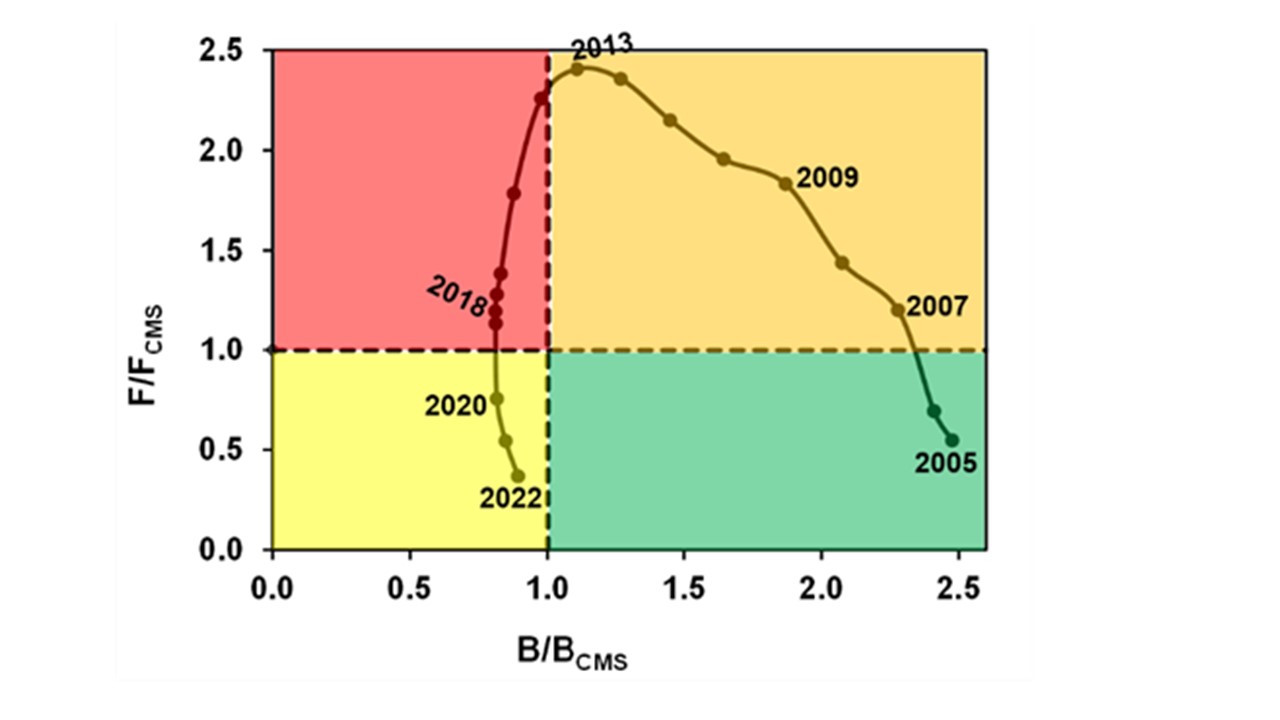
The Isostichopus badionotus sea cucumber fishery in the Isla de la Juventud region of Cuba began in 2004. Currently, this fishing area is one of the few that remain active, so updating the status of the resource and determining sustainable reference points for this area is of great importance. This research seeks to identify the best assessment model and determine sustainable reference points for this area. PESCAISLA sea cucumber fishery statistics were used, for catch (t) and fishing effort (fishing days) per season from November (year x) to May (year x+1), for the period 2005-2022. The catch per unit effort (CPUE) was determined for each year. The state of the resource was evaluated using dynamic models of surplus biomass production. To explore the most appropriate model, different variants of the Schaefer (1954) and Fox (1970) models with Hillborn and Walters (1992) method and the Pella and Tomlinson (1969) model as modified by Costello colaboradores (2016) were used. The best fit proved to be Pella-Tomlinson with lognormal process error and analytical calculation of q, the results of which were used to describe the status of the resource and define reference points for the management of its fishery. Four distinct stages in the fishery could be identified: healthy from 2005 to 2006, overfishing from 2007 to 2013, overfishing and depletion from 2014 to 2019 and depletion from 2020 to 2022 with a slight trend towards biomass recovery.
Downloads
References
Alfonso, I., Frías, M. P., Aleaga, L., & Alonso, C. R. (2004). Current status of the sea cucumber
fishery in the south eastern region of Cuba. En A. Lovatelli (comp/ed), C. Conand, S. Purcell, S., S. Uthicke, J. F. Hamel, & A. Mercier (Eds.). FAO AGRIS - International System for Agricultural Science and Technology.
Alzugaray-Martínez, R., Puga-Millán, R., Valle-Gómez, S., Hernández-Betancourt, A. (2023).
Evaluación de pesquerías cubanas con datos limitados: Transición metodológica hacia modelos basados en biomasa y sus implicaciones para el manejo. Revista Cubana de Investigaciones Pesqueras, 40(2), 64-69.
Betanzos-Vega, A., Alzugaray-Martínez, R., Puga-Millán, R., Tripp-Quezada, A., Mazón-
Suástegui, J. M. (2023). Evaluation of Cuban oyster resource status (Crassostrea spp.) and reference points for its management. Revista de Biología Marina y Oceanografía. 58(3), 177-185.
Branch, T. A., Jensen, O. P., Ricard, D., Ye, Y., Hilborn, R. A. Y. (2011). Contrasting global
trends in marine fishery status obtained from catches and from stock assessments. Conservation Biology, 25(4), 777-786. https://doi.org/10.1111/j.1523-1739.2011.01687.x
Costello, C., Ovando D., Clavelle T., Strauss C. K., Hilborn R., Melnychuk M. C., Branch T.A.,
Gaines S. D., Szuwalski C. S., Cabral R. B., Rader, D. N., & Leland, A. (2016). Global fishery prospects under contrasting management regimes. Proceedings of the National Academy of Sciences of the United States of America, 113(18), 5125-5129. https://doi.org/10.1073/pnas.1520420113
Espinoza Tenorio, A., Pech, Ramos, J., & Peña-Puch, A. (2012). Una radiografía antes de
decidir: El reto del aprovechamiento sustentable del pepino de mar en Campeche.
Investigación Ambiental, 4(1), 45-50.
Fox, W. W., Jr. (1970). An exponential surplus-yield model for optimizing exploited fish
populations. Transaction American Fisheries Society, 99(1), 80-88. https://doi.org/10.1577/1548-8659(1970)99<80:AESMFO>2.0.CO;2.
Frías, M. P., Afonso, I., Castelo, R., & Blas, Y. (2008). Variaciones talla-peso del pepino de
mar Isostichopus badionotus (Selenka, 1867) en las regiones sur oriental y sur occidental de Cuba. Revista Cubana de Investigaciones Pesqueras, 25(1), 38-45.
Froese, R., Demirel, N., Coro, G., Kleisner, K. M., & Winker, H. (2017). Estimating fisheries
reference points from catch and resilience. Fish and Fisherie,s 18(3), 506-526.
Froese, R., Winker, H., Coro, G., Palomares, M. L. D., Tsikliras, A. C., Dimarchopoulou, D.,
Touloumis, K., Demirel, N., Vianna, G. M. S., Scarcella, G., Schijns, R., Liang, C., Pauly, D. (2023). New developments in the analysis of catch time series as the basis for fish stock assessments: The CMSY++ method. Acta Ichthyologica et Piscatoria, 53, 173-189. https://doi.org/10.3897/aiep.53.105910
Haddon, M. (2011). Surplus Production Models. En Modeling and Quantitative, Methods in
Fisheries (2nd ed. pp. 285-333). CRC Press.
Hernandez-Betancourt, A., Puga Millán, R., Borroto Vejerano, R. (2018). Conservation strategy
for the sea cucumber (Isostichopus badionotus) fishery in Cuba. Bulletin of Marine Science, 94(2), 409-421. https://doi.org/10.5343/bms.2017.1005
Hernández-Flores, A., Cuevas-Jiménez, A., Poot-Salazar, A., Condal, A., Espinoza-Méndez, J.
C. (2018). Bioeconomic modeling for a small-scale sea cucumber fishery in Yucatan, Mexico. PLoS ONE, 13(1), Artículo e0190857. https://doi.org/10.1371/journal.pone.0190857
Hillborn, R., Walters C. J. (1992). Quantitative fisheries stock assessment. Choice, dynamics and
uncertainty. Chapman and Hall
López-Rocha, J. A. (2011, October 31-Novembre 5). Distribución y abundancia del pepino de
mar Isostichopus badionotus frente a la costa de Sisal Yucatán [Conferencia] Proceedings of the 64th Gulf and Caribbean Fisheries Institute, Puerto Morelos, Mexico.
Maunder, M. N., & Aires-da-Silva, A. (2012). Evaluation of the Kobe Plot and Strategy Matrix
and their application to tuna in the EPO. IATTC Stock Assessment Report 12.
Ortega, M. (2015). Evaluación de la pesquería del pepino de mar Isostichopus badionotus
(Aspidochirotida: Stichopopidae), al norte de la Isla de la Juventud, Cuba [Tesis de maestría, Instituto Politécnico Nacional, Centro Interdisciplinario de Ciencias Marinas]. Repositorio Digital Institucional. https://www.repositoriodigital.ipn.mx/jspui/bitstream/123456789/22357/1/ortegama1.pdf
Palomares, M. L. D., Froese, R., Derrick, B., Meeuwig, J. J., Nöel, S. L., Tsui, G., Woroniak, J.,
Zeller, D., & Pauly, D. (2020). Fishery biomass trends of exploited fish populations in marine ecoregions, climatic zones and ocean basins. Estuarine, Coastal and Shelf Science, 43, Artículo 106896. https://doi.org/10.1016/j.ecss.2020.106896
Pella, J. J, Tomlinson P. K. (1969). A generalized stock production model. Inter-American
Tropical Tuna Commission Bulletin, 13(3), 416-497.
Perry, R. I., Walters, C. J., & Boutillier, J. A. (1999). A framework for providing scientific
advice for the management of new and developing invertebrate fisheries. Reviews in Fish Biology and Fisheries, 9, 125-150. https://doi.org/10.1023/A:1008946522213
Purcell, S. W., A. Mercier, C. Conand, J.-F. Hamel, M. V. Toral-Granda, A. Lovatelli, & S.
Uthicke. (2013). Sea cucumber fisheries: Global analysis of stocks, management measures and drivers of overfishing. FISH and FISHERIES, 14(1), 34-59.
https://doi.org/10.1111/j.1467-2979.2011.00443.x
Quinn, G. P., Keough M. J. (2002). Experimental design and data analysis for biologist.
Cambridge University Press.
Schaefer, M. B. (1954). Some aspects of the dynamics of populations important to of
management commercial marine fisheries. Bulletin of the Inter-American Tropical Tunna
Commission, 1(2), 27-56.
Downloads
Published
How to Cite
Issue
Section
License
Copyright (c) 2026 Aracely Hernández Betancourt, Rafael Puga Millán, Patricia Canet Mullen

This work is licensed under a Creative Commons Attribution-NonCommercial-ShareAlike 4.0 International License.
El autor que publique en esta revista acepta las siguientes condiciones:
- El autor otorga a la Dirección General de Investigación el derecho de editar, reproducir, publicar y difundir el manuscrito en forma impresa o electrónica en la revista Ciencia, Tecnología y Salud.
- La Direción General de Investigación otorgará a la obra una licencia Creative Commons Atribución-NoComercial-CompartirIgual 4.0 Internacional