Enfermedad inflamatoria orbitaria: reporte de catorce casos
DOI:
https://doi.org/10.36829/63CTS.v12i2.1779Palabras clave:
Masa orbitaria, enfermedad orbitaria idiopática, pseudotumor ocular, inflamación ocular, Sindrome IgG4Resumen
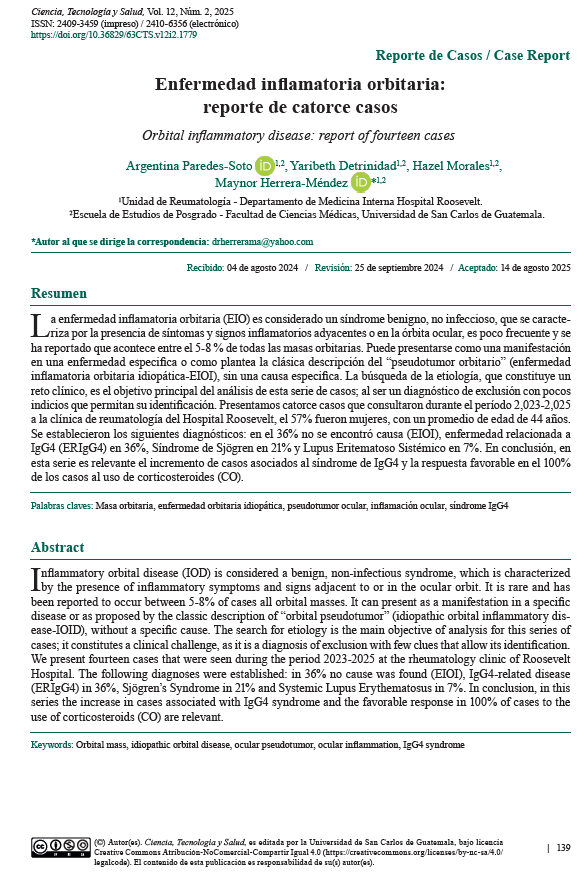
La enfermedad inflamatoria orbitaria (EIO) es considerado un síndrome benigno, no infeccioso, que se caracteriza
por la presencia de síntomas y signos inflamatorios adyacentes o en la órbita ocular, es poco frecuente y se
ha reportado que acontece entre el 5-8 % de todas las masas orbitarias. Puede presentarse como una manifestación
en una enfermedad especifica o como plantea la clásica descripción del “pseudotumor orbitario” (enfermedad
inflamatoria orbitaria idiopática-EIOI), sin una causa especifica. La búsqueda de la etiología, que constituye un
reto clínico, es el objetivo principal del análisis de esta serie de casos; al ser un diagnóstico de exclusión con pocos
indicios que permitan su identificación. Presentamos catorce casos que consultaron durante el período 2,023-2,025
a la clínica de reumatología del Hospital Roosevelt, el 57% fueron mujeres, con un promedio de edad de 44 años.
Se establecieron los siguientes diagnósticos: en el 36% no se encontró causa (EIOI), enfermedad relacionada a
IgG4 (ERIgG4) en 36%, Síndrome de Sjögren en 21% y Lupus Eritematoso Sistémico en 7%. En conclusión, en
esta serie es relevante el incremento de casos asociados al síndrome de IgG4 y la respuesta favorable en el 100%
de los casos al uso de corticosteroides (CO).
Descargas
Citas
Ardila-Suarez, O., Abril, A., & Gómez-Puerta, J. A. (2017). Enfermedad relacionada con IgG4: Revisión concisa de la literatura. Reumatología Clínica, 13(3), 160-166. https://doi.org/10.1016/j.reuma.2016.05.009
Biljsma, W. R. (2011). Progress in etiology, diagnosis, and treatment of idiopathic orbital inflammatory diseases. Utrecht University, Faculty of Medicine, the Netherlands.
Corbitt, K., & Nowatzky, J. (2023). Inflammatory eye disease for rheumatologists. Current Opinion in Rheumatology, 35(3), 201-212. https://doi.org/10.1097/BOR.0000000000000933
Das, D., Deka, P., Bhattacharjee, K., Das, J., Kuri, G., Bhattaacharjee, H., Deori, N., Deshmukh, S., Paidi, R., & Deka, A. (2019). Idiopathic inflammatory diseases of orbit and ocular adnexa: Histopathological and immunochemical analysis. Indian Journal of Ophthalmology, 67(12), Artículo 1993. https://doi.org/10.4103/ijo.IJO_2120_18
Duke-Elder, S., & MacFaul, PA. (1975). Chronic orbital inflammations. In: Duke-Elder S, ed.
System of Ophthalmology. St Louis, MO: CV Mosby Co., Vol. 8, Part II.:889–99.
Eshraghi, B., Sonbolestan, S. A., Abtahi, M.-A., & Mirmohammadsadeghi, A. (2019). Clinical characteristics, histopathology, and treatment outcomes in adult and pediatric patients with nonspecific orbital inflammation. Journal of Current Ophthalmology, 31(3), 327-334. https://doi.org/10.1016/j.joco.2019.03.004
Fang, Y., Shen, B., Dai, Q., Xie, Q., Wu, W., & Wang, M. (2023). Orbital inflammatory pseudotumor: new advances in diagnosis, pathogenesis, and treatment. European Journal of Medical Research, 28(1), Artículo 395. https://doi.org/10.1186/s40001-023-01330-0
Ferry, J. A., Klepeis, V., Sohani, A. R., Harris, N. L., Preffer, F. I., Stone, J. H., Grove, A., & Deshpande, V. (2015). IgG4-related orbital disease and its mimics in a western population. American Journal of Surgical Pathology, 39(12), 1688-1700. https://doi.org/10.1097/PAS.0000000000000497
Kogami, M., Abe, Y., Ando, T., Makiyama, A., Yamaji, K., & Tamura, N. (2023). Performance of classification and diagnostic criteria for IgG4-related disease and comparison of patients with and without IgG4-related disease. Scientific Reports, 13(1), Artículo 2509. https://doi.org/10.1038/s41598-023-29645-2
Lee, M. J., Planck, S. R., Choi, D., Harrington, C. A., Wilson, D. J., Dailey, R. A., Ng, J. D., Steele, E. A., Hamilton, B. E., Khwarg, S. I., & Rosenbaum, J. T. (2021). Non-specific orbital inflammation: Current understanding and unmet needs. Progress in Retinal and Eye Research, 81, Artículo 100885. https://doi.org/10.1016/j.preteyeres.2020.100885
Molina, J. F., Molina, J., García, C., Gharavi, A. E., Wilson, W. A., & Espinoza, L. R. (1997). Ethnic differences in the clinical expression of systemic lupus erythematosus: A comparative study between African-Americans and Latin Americans. Lupus, 6(1), 63-67. https://doi.org/10.1177/096120339700600109
Mombaerts, I., Bilyk, J. R., Rose, G. E., McNab, A. A., Fay, A., Dolman, P. J., Allen, R. C., Devoto, M. H., & Harris, G. J. (2017). Consensus on Diagnostic Criteria of Idiopathic Orbital Inflammation Using a Modified Delphi Approach. Journal of the American Medical Association Ophthalmology, 135(7), 769-776. https://doi.org/10.1001/jamaophthalmol.2017.1581
Perugino, C. A., & Stone, J. H. (2020). IgG4-related disease: an update on pathophysiology and implications for clinical care. Nature Reviews Rheumatology, 16(12), 702-714. https://doi.org/10.1038/s41584-020-0500-7
Rootman, J. (1998). Why “orbital pseudotumour” is no longer a useful concept. British Journal of Ophthalmology, 82(4), 339-340. https://doi.org/10.1136/bjo.82.4.339
Sweeney, A. R., Keene, C. D., Cimino, P. J., & Chang, S.-H. (2020). IgG4-positive Cell Quantification Distinguishes Between Inflammatory and Noninflammatory Diseases of the Orbit. Applied Immunohistochemistry & Molecular Morphology, 28(6), 448-452. https://doi.org/10.1097/PAI.0000000000000767
Young, S. M., Chan, A. S. Y., Jajeh, I. Al, Shen, S., Seah, L.-L., Choo, C.-T., Lang, S. S., & Looi, A. L. G. (2017). Clinical features and treatment outcomes of orbital inflammatory disease in Singapore: A 10-year clinicopathologic review. Ophthalmic Plastic & Reconstructive Surgery, 33(3), 182-188. https://doi.org/10.1097/IOP.0000000000000690
Yuen, S. J. A. (2003). Idiopathic Orbital Inflammation. Archives of Ophthalmology, 121(4), Artículo 491. https://doi.org/10.1001/archopht.121.4.491
Descargas
Publicado
Cómo citar
Número
Sección
Licencia
Derechos de autor 2026 Argentina Paredes Soto, Yaribeth Detrinidad, Hazel Morales, Maynor Alberto Herrera

Esta obra está bajo una licencia internacional Creative Commons Atribución-NoComercial-CompartirIgual 4.0.
El autor que publique en esta revista acepta las siguientes condiciones:
- El autor otorga a la Dirección General de Investigación el derecho de editar, reproducir, publicar y difundir el manuscrito en forma impresa o electrónica en la revista Ciencia, Tecnología y Salud.
- La Direción General de Investigación otorgará a la obra una licencia Creative Commons Atribución-NoComercial-CompartirIgual 4.0 Internacional