Evaluation of chitosan-bentonite composite membranes for apparent NaCl removal from synthetic brackish water
DOI:
https://doi.org/10.36829/08ASA.v20i1.2132Keywords:
saltwater, bentonite, sodium chloride, gravity filtration, chitosan membranes, interfacial polymerizationAbstract
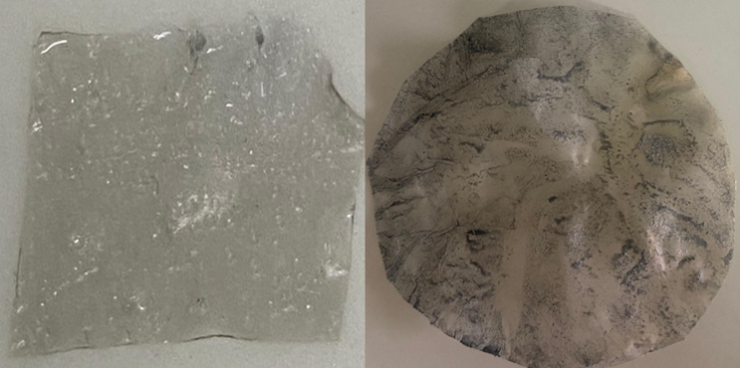
Chitosan-bentonite composite membranes were evaluated for apparent NaCl removal from synthetic brackish water using gravity-driven filtration. Chitosan supports were prepared by two procedures, and the active layer was obtained by interfacial polymerization with natural or CTAB-modified bentonite at 0.5%, 1%, and 5%. The membranes were characterized by physical, morphological, textural, and hydraulic properties, and apparent NaCl removal was estimated from changes in electrical conductivity. All membranes showed hydrophilic behavior and high permeability, with an average surface flux of 633.00 L/(m²·h) and an average volumetric flow of 0.010 mL/s. The highest adjusted apparent removal was 3.70% for the 1% Qt-A1 membrane, with an overall adjusted average of 1.00%; no statistically significant differences were found among membrane types or bentonite concentrations. The low removal could be associated with limited pore selectivity, heterogeneous bentonite distribution, particle agglomeration, and insufficient cation exchange. Qt-Bt membranes show potential as base materials for water treatment, but structural and chemical optimization is required to improve selectivity and stability.
Downloads
References
Aguilar, J. A., Badillo, M., García Castro, M. A., Varela Caselis, J. L., Solís Martínez, C., & Ortega P., J. (2020). Efecto de la concentración de glicerina en el desempeño de membranas de quitosano utilizadas en permeación en fase acuosa. Revista Mexicana de Ingeniería Química, 20(1), 87–96.
Al-Shaeli, M., Al-Juboori, R. A., Al Aani, S., Ladewig, B. P., & Hilal, N. (2022). Natural and recycled materials for sustainable membrane modification: Recent trends and prospects. Science of The Total Environment, 838, 156014. https://doi.org/10.1016/j.scitotenv.2022.156014
Arianita, A., Cahyaningtyas, Amalia, B., Pudjiastuti, W., Melanie, S., Fauzia, V., & Imawan, C. (2019). Effect of glutaraldehyde to the mechanical properties of chitosan/nanocellulose. Journal of Physics: Conference Series, 1317(1), 012045. https://doi.org/10.1088/1742-6596/1317/1/012045
Atamanova, O. V., Tikhomirova, E. I., Podoxenov, A. A., Vedeneeva, N. V., & Grishin, M. A. (2020). Adsorption of aromatic nitro and amino compounds with modified bentonite. IOP Conference Series: Materials Science and Engineering, 905(1), 012003. https://doi.org/10.1088/1757-899X/905/1/012003
Bocanegra, E. M., Quiroz Londoño, O. M., Grondona, S., & Martínez, D. E. (2022). Acuíferos costeros explotados intensamente: Modelo conceptual, respuesta hidrodinámica y simulación numérica del acuífero de Mar del Plata. Revista Argentina de Hidrogeología, 1(1), 58–78.
Cadotte, J. E. (1977). Reverse osmosis membrane (U.S. Patent No. 4,039,440). U.S. Patent and Trademark Office.
Dey, S., Al-Amin, M., Rashid, T., Sultan, Z., Ashaduzzaman, M., Sarker, M., & Shamsuddin, S. (2016). Preparation, characterization and performance evaluation of chitosan as an adsorbent for remazol red. International Journal of Latest Research in Engineering and Technology, 2, 52–62.
Grueso-Dominguez, M. C., Castro-Jiménez, C. C., Correa-Ochoa, M. A., & Saldarriaga-Molina, J. C. (2019). Estado del arte: Desalinización mediante tecnologías de membrana como alternativa frente al problema de escasez de agua dulce. Revista Ingenierías Universidad de Medellín, 18(35), 69–89. https://doi.org/10.22395/rium.v18n35a5
Guerrero-Gutiérrez, E. M. A., Abad, M., Gaitán, I., & Guerrero, K. (2022). Efecto de las membranas con Cu2+ sobre el proceso de filtración y capacidad de biocida contra Escherichia coli. Ciencia, Tecnología y Salud, 9(1), 98–115. https://doi.org/10.36829/63CTS.v9i1.1041
Hou, D., Ding, C., Li, K., Lin, D., Wang, D., & Wang, J. (2018). A novel dual-layer composite membrane with underwater-superoleophobic/hydrophobic asymmetric wettability for robust oil-fouling resistance in membrane distillation desalination. Desalination, 428, 240–249. https://doi.org/10.1016/j.desal.2017.11.039
Kadhom, M., & Deng, B. (2019). Thin film nanocomposite membranes filled with bentonite nanoparticles for brackish water desalination: A novel water uptake concept. Microporous and Mesoporous Materials, 279, 82–91. https://doi.org/10.1016/j.micromeso.2018.12.020
Li, W., Bai, Y., Ma, Q., Chen, W., Wu, M., & Ma, H. (2018). Polyacrylic acid/CTAB-bentonite coated filter paper: Efficient and rapid removal of anionic and cationic dyes. Applied Surface Science, 458, 903–909. https://doi.org/10.1016/j.apsusc.2018.07.169
Maldonado, E. (2017). Obtención y caracterización de membranas poliméricas para desalinización de agua [Tesis, Instituto Potosino de Investigación Científica y Tecnológica]. https://repositorio.ipicyt.edu.mx/handle/11627/3095
Paseta, L. (2019). Desarrollo de membranas nanocompuestas de película delgada basadas en materiales metal-orgánicos porosos y grafeno para su aplicación en nanofiltración [Tesis doctoral, Universidad de Zaragoza]. https://zaguan.unizar.es/record/106299/files/TESIS-2021-215.pdf
Purkait, M. K., Sinha, M. K., Mondal, P., & Singh, R. (2018). Stimuli responsive polymeric membranes: Smart polymeric membranes. Academic Press.
Reyes, C. A. (2017). Modelación del intercambio iónico de arcillas en un flujo turbulento de una pulpa con agua de mar dentro de una tubería [Tesis, Universidad de Chile].
American Public Health Association, American Water Works Association, & Water Environment Federation. (2017). Standard Methods for the Examination of Water and Wastewater (23rd ed.). American Public Health Association.
Sajjan, A. M., Premakshi, H. G., & Kariduraganavar, M. Y. (2015). Synthesis and characterization of GTMAC grafted chitosan membranes for the dehydration of low water content isopropanol by pervaporation. Journal of Industrial and Engineering Chemistry, 25, 151–161. https://doi.org/10.1016/j.jiec.2014.10.027
Shiguang, C., Hongwei, S., & Qiuli, C. (2021). Performance of an innovative gravity-driven micro-filtration technology for roof rainwater treatment. Environmental Engineering Research, 26(6), 200450. https://doi.org/10.4491/eer.2020.450
Stoffel, D., Derlon, N., Traber, J., Staaks, C., Heijnen, M., Morgenroth, E., & Jacquin, C. (2023). Gravity-driven membrane filtration with compact second-life modules daily backwashed: An alternative to conventional ultrafiltration for centralized facilities. Water Research X, 18, 100178. https://doi.org/10.1016/j.wroa.2023.100178
Thommes, M., Kaneko, K., Neimark, A. V., Olivier, J. P., Rodriguez-Reinoso, F., Rouquerol, J., & Sing, K. S. W. (2015). Physisorption of gases, with special reference to the evaluation of surface area and pore size distribution (IUPAC Technical Report). Pure and Applied Chemistry, 87(9–10), 1051–1069. https://doi.org/10.1515/pac-2014-1117
Vakili, M., Rafatullah, M., Salamatinia, B., Abdullah, A. Z., Ibrahim, M. H., Tan, K. B., Gholami, Z., & Amouzgar, P. (2014). Application of chitosan and its derivatives as adsorbents for dye removal from water and wastewater: A review. Carbohydrate Polymers, 113, 115–130. https://doi.org/10.1016/j.carbpol.2014.07.007
Vidal, R. R. L., & Moraes, J. S. (2019). Removal of organic pollutants from wastewater using chitosan: A literature review. International Journal of Environmental Science and Technology, 16(3), 1741–1754. https://doi.org/10.1007/s13762-018-2061-8
Wang, Y., Jiang, Q., Cheng, J., Pan, Y., Yang, G., Liu, Y., Wang, L., Leng, Y., & Tuo, X. (2021). Synthesis and characterization of CTAB-modified bentonite composites for the removal of Cs+. Journal of Radioanalytical and Nuclear Chemistry, 329(1), 451–461. https://doi.org/10.1007/s10967-021-07797-7
Worrall, W. E. (1968). Clays: Their nature, origin and general properties. Maclaren.
Downloads
Published
How to Cite
Issue
Section
License
Copyright (c) 2025 Agua, Saneamiento & Ambiente

This work is licensed under a Creative Commons Attribution-NonCommercial-ShareAlike 4.0 International License.