Ferrous clay as a coagulant for arsenic reduction in groundwater
DOI:
https://doi.org/10.36829/08ASA.v20i1.1945Keywords:
Arsenic, ferrous clay, coagulation, adsorption, groundwater, drinking water treatmentAbstract
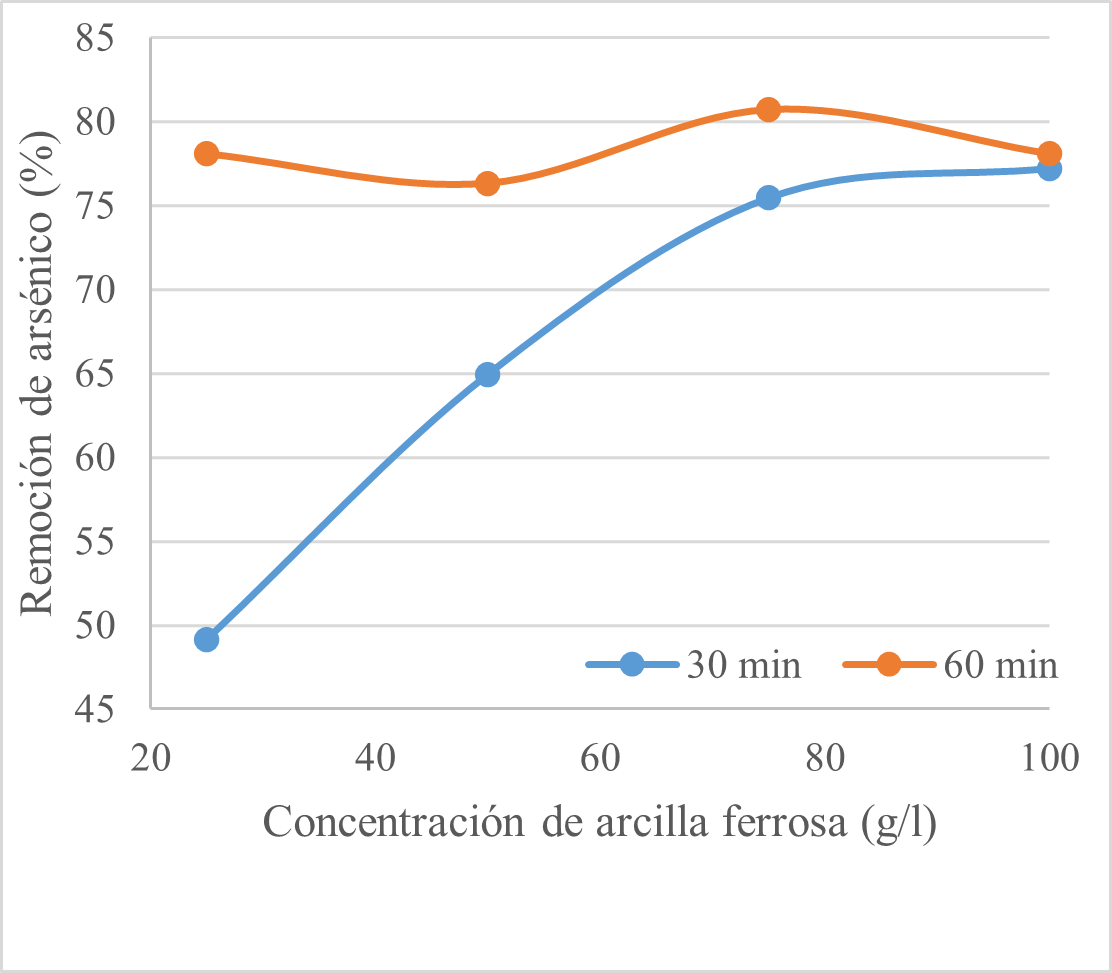
Arsenic is present in some mechanical wells in Guatemala, posing a health risk when water is consumed at concentrations exceeding the COGUANOR NTG 29001 standard. This study evaluated the efficiency of ferrous clay as a natural coagulant for reducing arsenic in groundwater. Ferrous clay was applied at doses expressed as concentration (25 to 100 g/L) combined with sedimentation times of 30 and 60 minutes, followed by filtration of the supernatant through a controlled-porosity ceramic element. Initial and final values of pH, electrical conductivity, turbidity, color, arsenic, and total iron were analyzed. Arsenic reductions ranged from 47.37% to 80.70%, reaching a minimum concentration of 0.011 mg/L, although the regulatory limit was not achieved. All other parameters remained within acceptable ranges, and no increase in total iron was observed in the evaluated treatments. The findings suggest that ferrous clay can contribute to partial arsenic reduction under laboratory conditions and could be considered as a preliminary treatment stage. Main limitations included the lack of mineralogical/textural characterization of the material, the limited number of replicates (n=2), and the lack of operational optimization (pH and mixing); additionally, the availability of arsenic-contaminated samples was constrained by limited access to affected wells.
Downloads
References
Argueta López, A. E. (2009). Aprovechamiento del agua subterránea y manejo sostenible de los recursos hidráulicos, en el Campus Central de la Universidad de San Carlos de Guatemala [Tesis de licenciatura, Facultad de Ingeniería, Universidad de San Carlos de Guatemala]. http://biblioteca.usac.edu.gt/tesis/08/08_3045_C.pdf
Agency for Toxic Substances and Disease Registry. (2007). Toxicological profile for arsenic. U.S. Department of Health and Human Services, Public Health Service. https://doi.org/10.15620/cdc:11481
Chiavola, A., D’Amato, E., Sirini, P., Caretti, C., & Gori, R. (2019). Arsenic removal from a highly contaminated groundwater by a combined coagulation-filtration-adsorption process. Water, Air, & Soil Pollution, 230, Article 87. https://doi.org/10.1007/s11270-019-4142-9
Inam, M. A., Khan, R., Lee, K.-H., & Wie, Y.-M. (2021). Removal of arsenic oxyanions from water by ferric chloride—Optimization of process conditions and implications for improving coagulation performance. International Journal of Environmental Research and Public Health, 18(18), 9812. https://doi.org/10.3390/ijerph18189812
Amiri, S., Vatanpour, V., & He, T. (2022). Optimization of coagulation-flocculation process in efficient arsenic removal from highly contaminated groundwater by response surface methodology. Molecules, 27(22), 7953. https://doi.org/10.3390/molecules27227953
Mayorga Moreno, M. P. (2013). Arsénico en aguas subterráneas: Su transferencia al suelo y a la planta [Tesis doctoral, Universidad de Valladolid]. https://uvadoc.uva.es/handle/10324/2821
Pooi, C. K., & Ng, H. Y. (2018). Review of low-cost point-of-use water treatment systems for developing communities. npj Clean Water, 1, Article 11. https://doi.org/10.1038/s41545-018-0011-0
Hao, L., Liu, M., Wang, N., & Li, G. (2018). A critical review on arsenic removal from water using iron-based adsorbents. RSC Advances, 8, 39545–39560. https://doi.org/10.1039/c8ra08512a
Romero Rojas, J. A. (1999). Tratamiento de aguas residuales: Teoría y principios de diseño. Escuela Colombiana de Ingeniería.
Smith Meléndez, E. F. (2007). Remoción de arsénico en el agua a nivel de laboratorio aplicando como medio filtrante óxido de hierro [Tesis de maestría, Escuela Regional de Ingeniería Sanitaria y Recursos Hidráulicos, Facultad de Ingeniería, Universidad de San Carlos de Guatemala]. http://biblioteca.usac.edu.gt/tesis/08/08_0386_MT.pdf
Veli Jiménez, L. E., & Álvarez Camarena, G. L. (2014). Remoción de arsénico mediante arcilla natural del agua procedente del manantial de Quero–Jauja [Tesis de licenciatura, Universidad Nacional del Centro del Perú]. https://repositorio.uncp.edu.pe/handle/20.500.12894/3719
COGUANOR. (s. f.). NTG 29001: Agua potable. Requisitos. Comisión Guatemalteca de Normas.
Sepúlveda Saa, R. (2009). El arsénico en la contaminación de aguas subterráneas. Ciencia UANL, 12(3), 239–244. https://www.redalyc.org/pdf/402/40211814002.pdf
Downloads
Published
How to Cite
Issue
Section
License
Copyright (c) 2025 Agua, Saneamiento & Ambiente

This work is licensed under a Creative Commons Attribution-NonCommercial-ShareAlike 4.0 International License.