Physicochemical characterization of wastewater from the morgue at Roosevelt Hospital
DOI:
https://doi.org/10.36829/08ASA.v20i1.2162Keywords:
hospital effluents, chemical oxygen demand, Biochemical oxygen demand, biodegradability, pollutant load, wastewaterAbstract
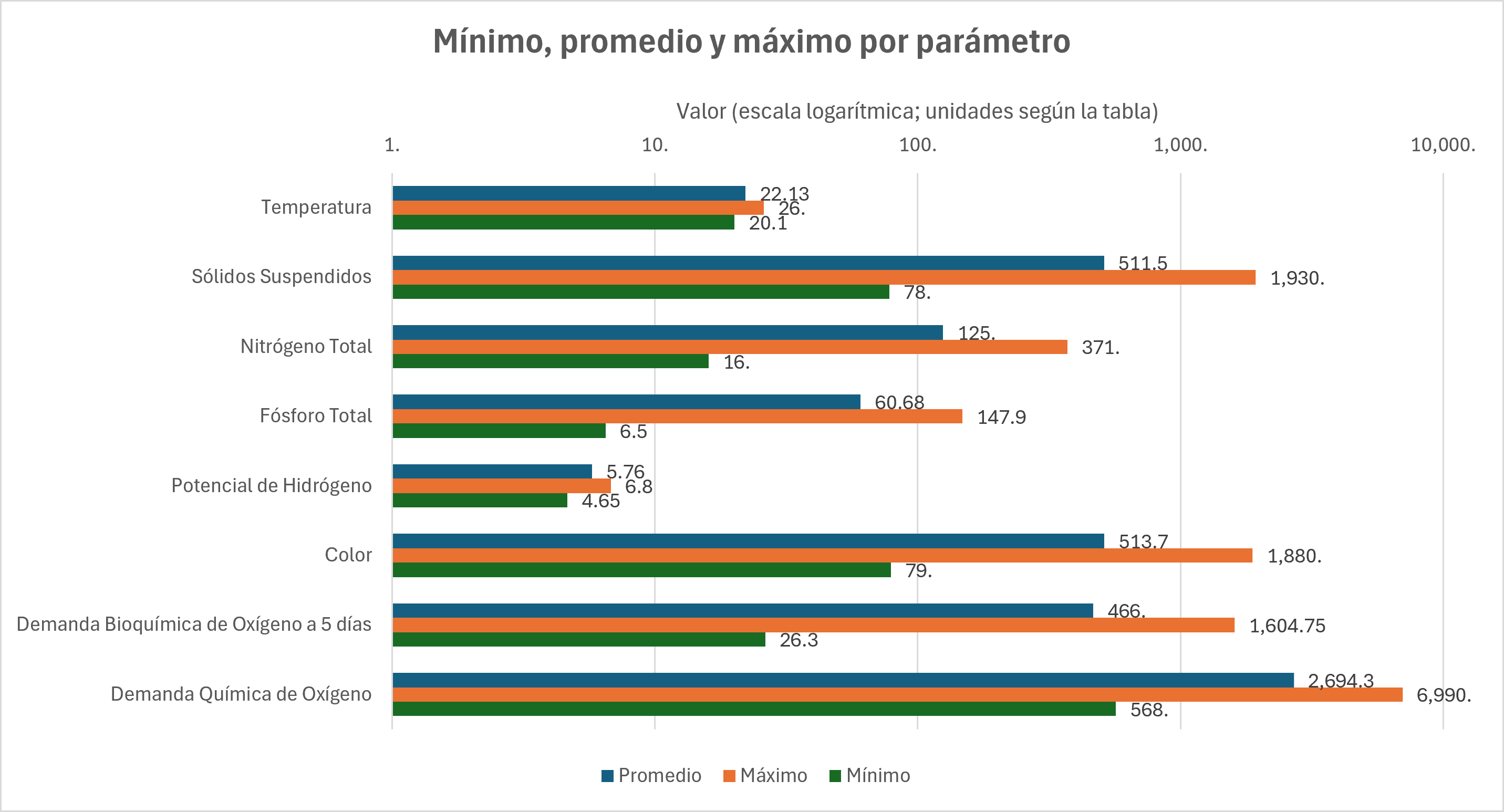
The physicochemical characteristics of wastewater generated in morgues had not previously been documented in Guatemala. The objective of this study was to characterize wastewater from the morgue of Hospital Roosevelt by determining flow rate, temperature, pH, total nitrogen, total phosphorus, color, suspended solids, five-day biochemical oxygen demand (BOD₅), and chemical oxygen demand (COD), as well as to assess its biodegradability and estimate its pollutant loads. Ten composite samples were collected between September and November 2025. Each composite sample consisted of four grab samples collected at one-hour intervals between 12:00 and 15:00. The average COD concentration was 2,694.30 mg/L, equivalent to 6.40 times the reference value for raw domestic wastewater in Guatemala. The BOD₅/COD ratio was 0.17, indicating low biodegradability. For the observed three-hour daily period, the estimated pollutant loads were 0.53 kg of BOD₅, 3.05 kg of COD, and 0.58 kg of suspended solids, with an average flow rate of 0.1047 L/s; these values were not extrapolated to 24 hours. The results provide a baseline to guide future research and evaluate treatment alternatives for this type of effluent.
Downloads
References
American Public Health Association, American Water Works Association, & Water Environment Federation. (1998). Standard methods for the examination of water and wastewater (20th ed.).
American Public Health Association, American Water Works Association, & Water Environment Federation. (2017). Standard methods for the examination of water and wastewater (23rd ed.).
Emmanuel, E., Perrodin, Y., Keck, G., Blanchard, J. M., & Vermande, P. (2005). Ecotoxicological risk assessment of hospital wastewater: A proposed framework for raw effluents discharging into urban sewer networks. Journal of Hazardous Materials, 117(1), 1–11. https://doi.org/10.1016/j.jhazmat.2004.08.032
Kümmerer, K. (2001). Drugs in the environment: Emission of drugs, diagnostic aids and disinfectants into wastewater by hospitals in relation to other sources - a review. Chemosphere, 45(6–7), 957–969. https://doi.org/10.1016/S0045-6535(01)00144-8
Kümmerer, K. (2009). The presence of pharmaceuticals in the environment due to human use—Present knowledge and future challenges. Journal of Environmental Management, 90(8), 2354–2366. https://doi.org/10.1016/j.jenvman.2009.01.023
Metcalf & Eddy, Inc., & AECOM. (2014). Wastewater engineering: Treatment and resource recovery (5th ed.). McGraw-Hill Education.
Ministerio de Ambiente y Recursos Naturales. (2008). Acuerdo Ministerial No. 105-2008: Manual general del Reglamento de las descargas y reúso de aguas residuales y de la disposición de lodos. Diario de Centro América, 52, 5-18.
Monge, M. A., & Del Cid, E. A. (2006). Análisis de la calidad del agua residual del Hospital General de Accidentes del Instituto Guatemalteco de Seguridad Social y propuesta de tratamiento [Tesis de maestría, Universidad de San Carlos de Guatemala]. http://biblioteca.usac.edu.gt/tesis/08/08_0472_MT.pdf
Montoya, L., Alape, G., & Gutiérrez, C.A. (2006). Diseño de un sistema de tratamiento de aguas residuales para el Instituto Nacional de Medicina Legal y Ciencias Forenses, sede Bogotá. [Tesis de grado, Universidad Industrial de Santander]. https://noesis.uis.edu.co/server/api/core/bitstreams/ba7cf890-f206-4ff7-8731-6c5858a44065/content
Orias, F., & Perrodin, Y. (2013). Characterisation of the ecotoxicity of hospital effluents: A review. Science of the Total Environment, 454–455, 250–276. https://doi.org/10.1016/j.scitotenv.2013.02.064
Peralta Salgado, I.N. (2016). Composición típica de las aguas residuales domésticas crudas en Guatemala. Agua, Saneamiento & Ambiente, 11(1), 54-63. https://doi.org/10.36829/08ASA.v11i1.1444
Verlicchi, P., Al Aukidy, M., & Zambello, E. (2015). What have we learned from worldwide experiences on the management and treatment of hospital effluent? An overview and a discussion on perspectives. Science of the Total Environment, 514, 467–491. https://doi.org/10.1016/j.scitotenv.2015.02.020
World Health Organization. (2014). Safe management of wastes from health-care activities (2nd ed.). https://www.who.int/publications/i/item/9789241548564
Downloads
Published
How to Cite
Issue
Section
License
Copyright (c) 2025 Agua, Saneamiento & Ambiente

This work is licensed under a Creative Commons Attribution-NonCommercial-ShareAlike 4.0 International License.