Comparación experimental de SBR e IFAS-MBBR para remoción de nitrógeno en aguas residuales de complejo logístico
DOI:
https://doi.org/10.36829/08ASA.v20i1.2127Palabras clave:
aguas residuales especiales, nitrificación, desnitrificación, biomasa adherida, reactor biológico secuencial, tratamiento biológicoResumen
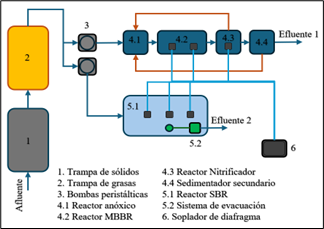
EEl tratamiento de aguas residuales especiales de complejos logísticos presenta desafíos técnicos por altas concentraciones de nitrógeno y baja relación carbono/nitrógeno (C/N), condiciones que limitan procesos biológicos convencionales. Este estudio comparó un reactor biológico secuencial (SBR, Sequencing Batch Reactor) y un sistema híbrido IFAS-MBBR (Integrated Fixed-Film Activated Sludge–Moving Bed Biofilm Reactor) para evaluar su eficiencia en la remoción de nitrógeno. Se determinó cuál configuración presentó mayor eficiencia y estabilidad operativa para la remoción de nitrógeno total bajo condiciones reales de baja relación C/N. Ambos sistemas operaron a escala piloto con agua residual real posterior al pretratamiento de un complejo logístico, a 20 L/día e inoculados con lodo activado de la planta existente; el SBR se configuró con SRT de diseño de 30 días y aireación cíclica, y el IFAS-MBBR con SRT de diseño de 25 días y aireación intermitente. Durante la fase estable se realizaron 24 eventos de muestreo. El SBR presentó mayor eficiencia promedio de remoción de nitrógeno total (45.5 ± 17 %) que el IFAS-MBBR (31.7 ± 20 %), con diferencias estadísticamente significativas (p ≤ 0.05). Bajo las condiciones evaluadas, los resultados sugirieron que el SBR puede ser preferible en aplicaciones piloto o de pequeña escala con baja disponibilidad relativa de carbono. El escalamiento económico, energético y ambiental se interpretó como aproximación conceptual preliminar, no como diseño ejecutivo ni validación a escala real.
Descargas
Citas
Awad, H., Mossad, M., Mahanna, H., Foad, M., El-Badawy, A., & Gar Alalm, M. (2024). Performance and life cycle assessment of moving-bed biofilm and integrated fixed-film reactors to upgrade activated sludge systems. Journal of Cleaner Production, 449, 141624. https://doi.org/10.1016/j.jclepro.2024.141624
Aygun, A., Nas, B., & Berktay, A. (2008). Influence of high organic loading rates on COD removal and sludge production in moving bed biofilm reactor. Environmental Engineering Science, 25(9), 1311–1316. https://doi.org/10.1089/ees.2007.0071
Benavides-Sánchez, J., Vuono, M., & Dionisi, D. (2021). Model-based comparison of sequencing batch reactors and continuous-flow activated sludge processes for biological wastewater treatment. Computers & Chemical Engineering, 144, 107127. https://doi.org/10.1016/j.compchemeng.2020.107127
Dolatshah, M., Asadi, A., Gholami, F., & Nazari, S. (2024). Development and modeling of an integrated fixed-film activated sludge (IFAS) system for simultaneous nitrogen and carbon removal from an industrial estate wastewater. Biotechnology Reports, 41, e00831. https://doi.org/10.1016/j.btre.2024.e00831
Fu, X., Hou, R., Yang, P., Qian, S., Feng, Z., Chen, Z., Wang, F., Yuan, R., Chen, H., & Zhou, B. (2022). Application of external carbon source in heterotrophic denitrification of domestic sewage: A review. Science of the Total Environment, 817, 153061. https://doi.org/10.1016/j.scitotenv.2022.153061
Gu, S., Liu, L., Zhuang, X., Qiu, J., & Zhou, Z. (2022). Enhanced nitrogen removal in a pilot-scale anoxic/aerobic (A/O) process coupling PE carrier and nitrifying bacteria PE carrier: Performance and microbial shift. Sustainability, 14(12), 7193. https://doi.org/10.3390/su14127193
Kargi, F., & Uygur, A. (2003). Nutrient loading rate effects on nutrient removal in a five-step sequencing batch reactor. Process Biochemistry, 39(4), 507–512. https://doi.org/10.1016/S0032-9592(03)00135-3
Khan, N. A., Singh, S., Ramamurthy, P. C., & Aljundi, I. H. (2024). Exploring nutrient removal mechanisms in column-type SBR with simultaneous nitrification and denitrification. Journal of Environmental Management, 349, 119485. https://doi.org/10.1016/j.jenvman.2023.119485
Khudhair, D. N., Hosseinzadeh, M., Zwain, H. M., Siadatmousavi, S. M., Majdi, A., & Mojiri, A. (2023). Upgrading the MBBR process to reduce excess sludge production in activated sludge system treating sewage. Water, 15(3), 408. https://doi.org/10.3390/w15030408
Liang, Z., Yi, J., Gu, Q., & Dai, X. (2022). Metagenomics reveals a modified large-scale IFAS process with enhanced nitrogen removal and reduced sludge production. Science of the Total Environment, 841, 156666. https://doi.org/10.1016/j.scitotenv.2022.156666
Phanwilai, S., Kangwannarakul, N., Noophan, P., Kasahara, T., Terada, A., Munakata-Marr, J., & Figueroa, L. A. (2020). Nitrogen removal efficiencies and microbial communities in full-scale IFAS and MBBR municipal wastewater treatment plants at high COD:N ratio. Frontiers of Environmental Science & Engineering, 14, 115. https://doi.org/10.1007/s11783-020-1374-2
Puig, S., Vives, M. T., Corominas, L., Balaguer, M. D., & Colprim, J. (2004). Wastewater nitrogen removal in SBRs applying a step-feed strategy: from lab-scale to pilot-plant operation. Water Science & Technology, 50(10), 89–96. https://doi.org/10.2166/wst.2004.0617
Puig, S., Coma, M., van Loosdrecht, M. C. M., Colprim, J., & Balaguer, M. D. (2007). Biological nutrient removal in a sequencing batch reactor using ethanol as carbon source. Journal of Chemical Technology & Biotechnology, 82(10), 898–904. https://doi.org/10.1002/jctb.1754
Tran, H. Q., Gogina, E., Makisha, N., Gulshin, I., & Makisha, E. (2023). Improving nitrogen removal efficiency in SBR reactors by controlling operational phases. Applied Sciences, 13(19), 10906. https://doi.org/10.3390/app131910906
Zhao, R., Zhao, H., Dimassimo, R., & Xu, G. (2018). Pilot scale study of sequencing batch reactor (SBR) retrofit with integrated fixed film activated sludge (IFAS): nitrogen removal and design considerations. Environmental Science: Water Research & Technology, 4(4), 569–581. https://doi.org/10.1039/C7EW00337D
Descargas
Archivos adicionales
Publicado
Cómo citar
Número
Sección
Licencia
Derechos de autor 2025 Agua, Saneamiento & Ambiente

Esta obra está bajo una licencia internacional Creative Commons Atribución-NoComercial-CompartirIgual 4.0.